





Is the Spanish Language Difficult to Learn? Not if You’re Having Fun Doing it!
How many hours it really takes, which parts of Spanish are easy, which ones are hard, and why enjoying it speeds the whole thing up.

Equipo Mister Fox
June 27, 2021 · Updated on July 30, 2026 · 6 min read

It is the question that arrives in the first email, before price and before schedules: how hard is it? The honest answer has two parts. Compared with other languages, Spanish sits among the most accessible for an English speaker. And within Spanish, some things come almost for free while others will cost you.
The short answer, measured in hours
The US Foreign Service Institute has spent decades training diplomats and tracking how long they take to reach professional working proficiency. Its figures are the most quoted reference because they come from thousands of real students rather than desk estimates.
Spanish sits in the most accessible category: between 600 and 750 class hours. That is the lowest figure on the whole table, shared with French, Italian and Portuguese.
| Language | Approximate class hours |
|---|---|
| Spanish, French, Italian, Portuguese | 600 to 750 |
| German | around 900 |
| Russian, Hindi, Turkish, Vietnamese | around 1,100 |
| Arabic, Chinese, Japanese, Korean | around 2,200 |
Translated into real life: at two hours a day, Monday to Friday, those six hundred hours take a little over a year. At one class a week, twelve.
What makes Spanish easy
It is written the way it sounds
This is the biggest advantage and the least mentioned one. In Spanish, each letter almost always maps to the same sound. If you know how a word is spelled, you know how to say it, and the other way round. Compare that with English, where through, though, tough and thought share nearly the same letters and no pronunciation at all.
Five vowels, and always the same five
Spanish has five vowel sounds that never shift. English has more than twice as many, with distinctions a Spanish speaker takes years to even hear. In practice this means your Spanish accent will be understandable far sooner than you expect.
You already know thousands of words
English borrowed from Latin for centuries, so a large part of the formal vocabulary overlaps. Some patterns work nearly every time:
- Words ending in -tion become -ción: information, información.
- Words in -ty become -dad: university, universidad.
- Words in -ly become -mente: exactly, exactamente.
- Words in -ous become -oso: famous, famoso.
- Words in -ent and -ant usually stay put: important, importante.
Those five patterns hand you several thousand words on day one. Not all of them work, which is where false friends come from, but the hit rate is high.
What actually is hard
No language is easy all the way through. These are the four areas where almost everyone gets stuck, and it helps to know them in advance so you do not read them as a lack of talent.
- The sheer number of conjugations. A Spanish verb has dozens of forms where English has five. The reassuring part is that the present, the preterite and the ir a future are enough to communicate.
- The subjunctive. It has no direct English equivalent and is not learned from a rule but from exposure. It arrives late, but it does arrive.
- Ser and estar, por and para. Two pairs that English handles with a single word each. You master them through fixed phrases, not tables.
- Noun gender. La mesa, el problema. There are patterns, there are exceptions, and getting it wrong does not stop people understanding you.
That last clause is worth underlining. Nearly all of these errors are cosmetic: they grate on a teacher's ear and they do not block communication. Focusing first on what genuinely stops people understanding you is what makes progress visible.
Why enjoying it is not decoration
Here is the part that sounds like a slogan and is not. The variable that best predicts whether someone ends up speaking a language is neither talent nor method, it is how many hours they accumulate. And nobody accumulates hours doing something they hate.
Language teaching has talked for decades about the affective filter: the idea that anxiety and boredom block learning even when the material is good. You do not have to buy the whole theory to recognize the phenomenon. Everyone has abandoned a perfectly designed course out of sheer tedium.
What fun means in practice
It does not mean games in class. It means content you would have consumed anyway in your own language.
- If you cook, recipe videos without subtitles.
- If you follow football, the commentary on a Colombian match.
- If you like music, salsa or reggaeton lyrics, which come loaded with real slang.
- If you read, a book you already know, this time in Spanish.
- If you listen to podcasts, a Colombian one on a subject you already care about.
The test is simple: if you finish wanting to know what happens next, it works. If you drop it after five minutes, it does not matter how pedagogical it is.
If you already speak another language
Speakers of French, Italian or Portuguese start with a considerable head start: the structure is the same and much of the vocabulary is too. Portuguese is the extreme case, with partial comprehension from day one.
And it runs both ways. For a Colombian learning English, the difficulties swap places: English grammar is simpler, but the spelling follows no phonetic logic, phrasal verbs are a universe of their own, and the vowels take years. Equally accessible, with different obstacles.
How long it will take you
The Foreign Service Institute's 600 hours refer to intensive training with teachers and small groups. Your real figure depends on three things: how many hours a week you can sustain, how much exposure you get outside class, and whether the course level is properly calibrated.
That last factor is always underestimated. Half a level too high produces exhaustion, half a level too low produces boredom. That is why we start with a placement test: it is not a formality, it is what stops you losing a whole month.
The second factor solves itself if you are in Colombia. In Laureles in Medellín, or in central Pereira, English is not the default language, so every lunch and every errand adds hours that never show up on the invoice.
Nobody gives up on a language because it is difficult. They give up because it stopped being interesting.
Where to start
Before counting hours, it helps to know where you stand. A short test and fifteen minutes of conversation are enough to place your real level and estimate how many weeks you need for whatever goal you have in mind.
New students then get a 30-minute trial class, with no commitment.
Learn Spanish with us in Colombia
Mister Fox Spanish School is a licensed school (ETDH) with campuses in Pereira and Medellín (Laureles and Belén): small groups, real teachers and a free trial class.
Recent articles
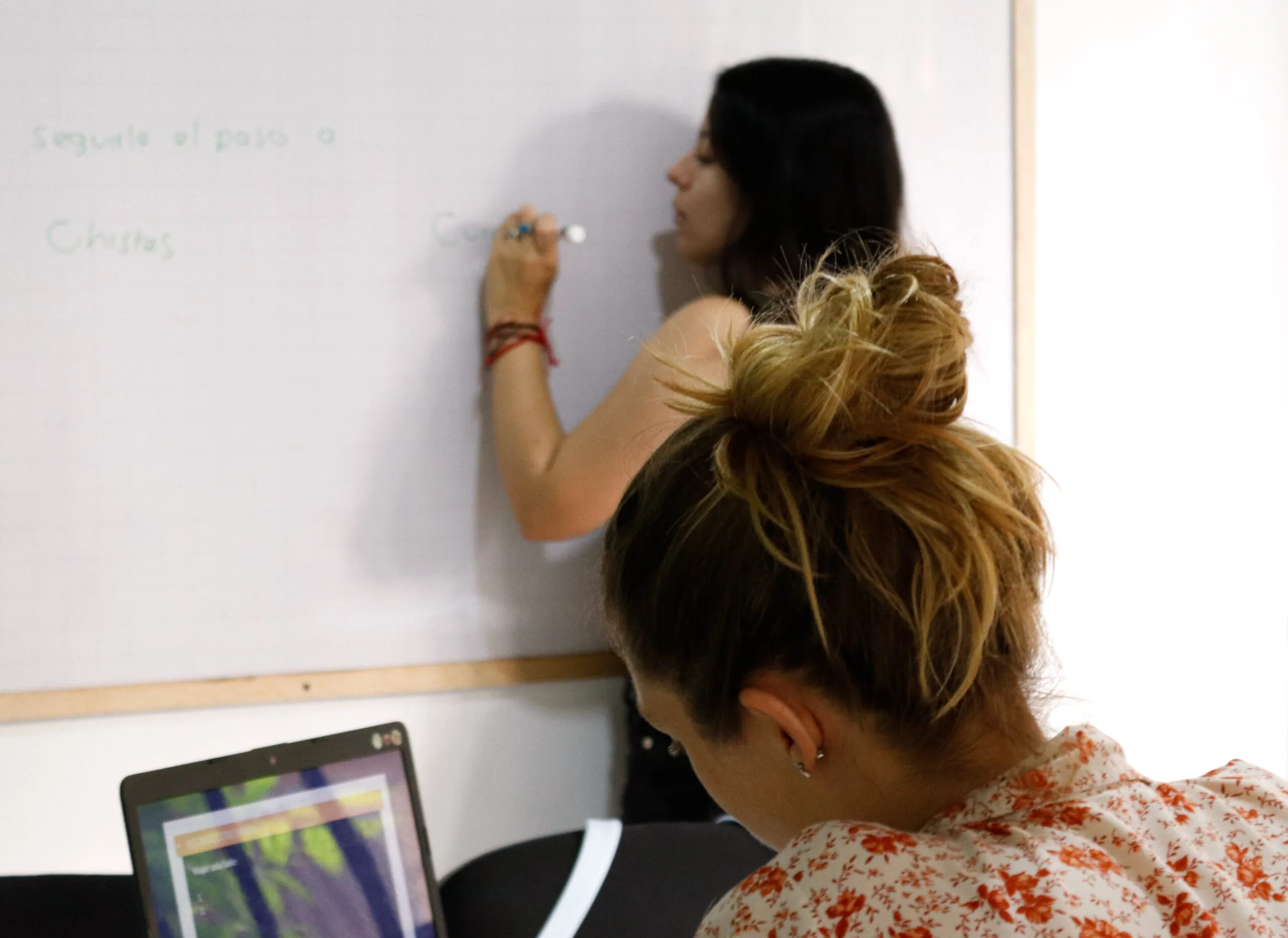
Embrace Your Journey: Overcoming the Top 5 Basic Mistakes in Learning Spanish with Mister Fox Spanish School
The five habits that slow down almost every Spanish learner in Colombia, and what tends to work instead in Medellín and Pereira.
July 30, 2026 · 5 min read
25 Spanish phrases you'll actually use in your first week in Colombia
From ¿Qué más? to a la orden: the phrases you will really hear on day one in Colombia, with translations and tips to use them like a local.
July 2, 2026 · 4 min read
The best time to move to Medellín or Pereira (weather, festivals, timing your course)
Eternal-spring weather, rainy seasons, the Feria de las Flores and visa timelines: how to pick the right month to start your Spanish course in Colombia.
June 25, 2026 · 4 min read