








Language exchanges: free practice with locals who want your English
What intercambios are, how the 50/50 rule works and how to get free Spanish practice with locals in Medellín and Pereira, even if you are shy.
The best-kept open secret of learning Spanish in Colombia: thousands of locals want to practice English as badly as you want to practice Spanish. Put both groups in a room with coffee and you get the intercambio, the highest-value free activity in your language learning.
What an intercambio is
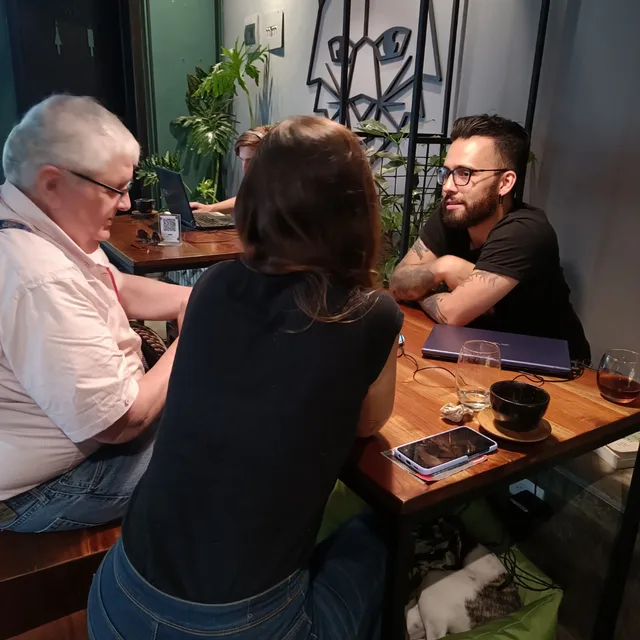
A language exchange (intercambio de idiomas) is a meetup where Spanish speakers learning English and English speakers learning Spanish pair up or form small groups and talk, half the time in one language and half in the other. No teacher grading you, no textbook, no fee: just conversation, which is the one thing no app can simulate and the skill most students are missing. In Medellín and Pereira the raw material is exceptional: paisas are chatty, patient with learners and curious about foreigners. You are not imposing; you are the most interesting person at the table.
The 50/50 rule
Every good intercambio runs on one rule: half the time in Spanish, half in English, switching at an agreed signal. Without it, exchanges collapse into whichever language flows easiest, which usually means the stronger English speaker carries the night and nobody improves. With it, both sides get their reps and struggling becomes normal instead of embarrassing. If your table drifts, be the one who says “bueno, ahora en español”. Everyone quietly thanks you.
Our intercambios are part of school life
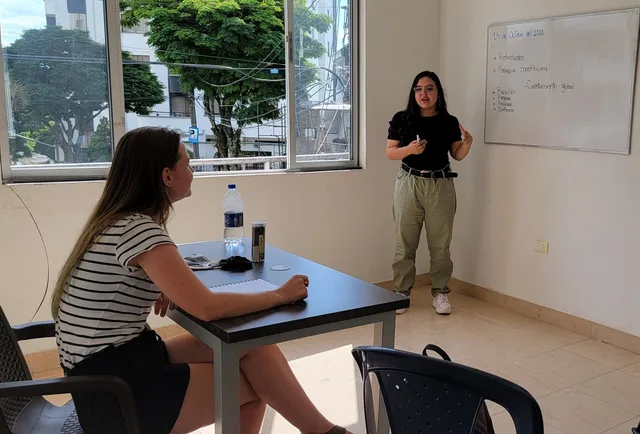
We run intercambios and social activities as part of the school calendar at all three campuses: Laureles (Carrera 76 #41-07) and Belén (Cl. 32F #74B-136) in Medellín, and La Rebeca (Carrera 11B #1A-40) in Pereira. They sit next to salsa nights, coffee tours and group trips on our activities calendar, and they solve the cold-start problem: the locals who come are there to meet students like you, and our team hosts, so nobody stands in a corner holding a lemonade. They also answer a question we hear every week, why a school bothers hosting free events: classes build the engine and conversation is the road, and students who pair classes with weekly real-world speaking outpace students who only study.
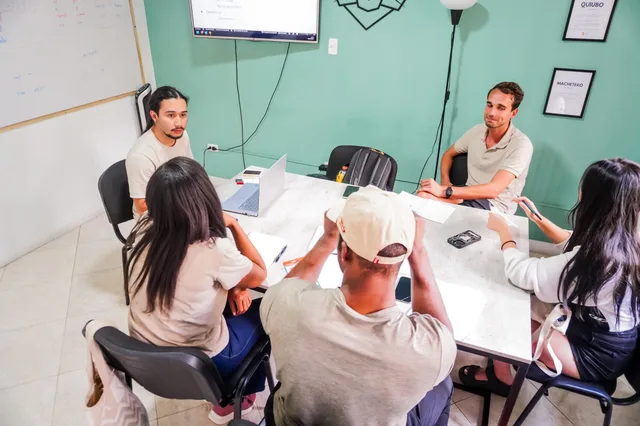
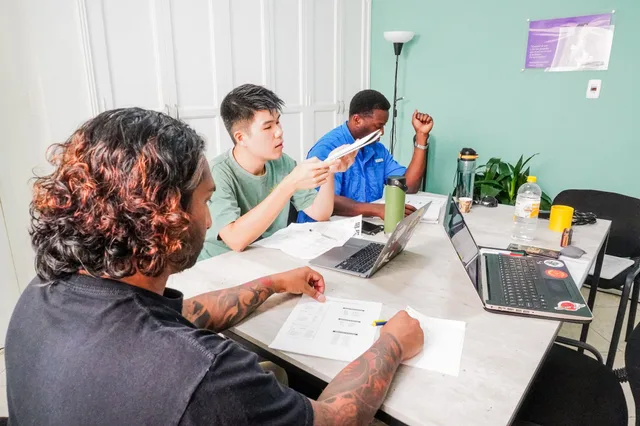
A typical night: you arrive, get paired with a mix of locals and students, warm up with an icebreaker so nobody has to invent an opening line, and talk, half the clock in Spanish and half in English, with our team rescuing stalled tables and refereeing the switch. Rotations mean you meet several people in one evening, and the same faces come back week after week, which is how acquaintances become your parche.
Shy? Use the cheat sheet
The students who dread intercambios most are usually the ones who gain the most; our teachers see it every term. If a room of strangers in a language you half speak sounds terrifying, use the system:
- Arrive with three prepared questions: “¿De dónde eres?”, “¿Qué me recomiendas comer aquí?”, “¿Qué significa parce?”. That last one buys you ten minutes at least.
- Bring a classmate. A duo can rescue each other, and if you ask around before class you will find you are not the only nervous one.
- Set a tiny goal: survive fifteen minutes of Spanish. You will stay longer, but a small goal gets you through the door.
- Steal from your lessons: whatever grammar you learned this week, force it into one sentence tonight. That is when it becomes yours.
- Remember the asymmetry: half the room is nervous about their English. You are someone else’s scary native speaker.
It helps to arrive with a base. One week of classes gives you enough scaffolding to hold an exchange, and a skim through our paisa slang guide means the greetings will not ambush you. Once “¿qué más pues?” stops being a mystery, the room gets a lot friendlier.
Etiquette
- Respect the switch. When it is Spanish time, struggle nobly in Spanish; your partner does the same in English.
- Bring an opener. “¿Qué me recomiendas hacer este fin de semana?” works with anyone, and a “¿qué más pues?” delivered with confidence makes the table adopt you on the spot.
- Correct gently and only when asked, and say what you want corrected in your own Spanish. Nobody signed up for a grammar audit.
- Ask questions and listen. The fastest progress comes from caring about the answer, not rehearsing your next sentence.
- Exchange contacts when it clicks. The real prize is the follow-up coffee, in Spanish, next week.
- Show up regularly. One visit makes conversation; five visits make friends.
Beyond the intercambio
Conversation practice hides everywhere in school life: salsa nights (counting steps in Spanish counts), coffee tours, group hikes and the hundred small chats of daily life in Laureles, Belén or La Rebeca. The activities calendar bundles the best of it. One caveat: an intercambio complements classes, it does not replace them. Free conversation makes you fluent in the mistakes you already have unless something feeds you new structures, so the students who improve fastest learn it in the morning and try it on a stranger by night.
Frequently asked questions
What is an intercambio de idiomas?
A language exchange: a meetup where Spanish speakers learning English and English speakers learning Spanish pair up and talk, half the time in one language and half in the other. No teacher grading you, no textbook, no fee, and a lot of coffee.
Are the Mister Fox intercambios free?
Yes. They are part of the school calendar at all three campuses, Laureles and Belén in Medellín and La Rebeca in Pereira, and our team hosts: it pairs people, runs the icebreaker and referees the switch between languages. Dates are on the activities calendar.
What is the 50/50 rule?
Half the time in Spanish, half in English, switching at an agreed signal and without negotiation. Without it, exchanges collapse into whichever language flows easiest and nobody improves; with it, both sides get their practice and struggling becomes normal.
I am shy. Can I still join?
Shy students are the ones who gain the most. Arrive with three prepared questions, bring a classmate and set a tiny goal, such as fifteen minutes of Spanish. The events are hosted, rotations are built in and half the room is nervous about their English.
How much Spanish do I need for an intercambio?
Less than you fear. One week of classes gives you enough scaffolding to hold an exchange, and complete beginners come with three prepared questions and a classmate. Half of your partner’s time is spent in English anyway, so the evening does not depend on your grammar; it depends on showing up.
How often should I go?
Weekly, if you can. One visit makes conversation and five visits make friends, because the same locals come back and remember you. A weekly rhythm also gives you a place to try whatever grammar the class covered that week, which is how it stops being a rule and becomes a habit.
Free intercambios in Medellín and Pereira, hosted by the school.
Spanish is also learned outside the classroom
Salsa nights, language exchanges, coffee tours and trips to the Cocora Valley: practice what you learn with students from all over the world.
No dates are published right now. Check the full calendar or message us: we will tell you about the next one.
Your Spanish starts today (and your first class is free)
Your first package gets −10% off on selected plans, applied automatically. See you in Medellín, Pereira or online.